
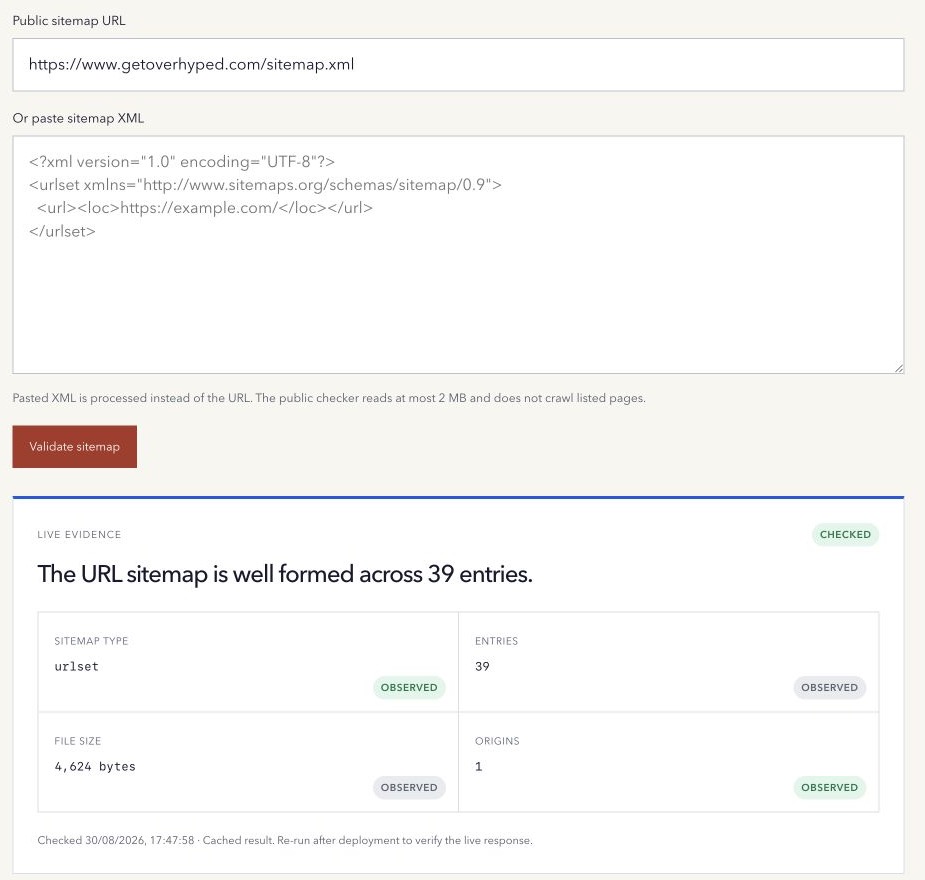
A sitemap can pass XML parsing and still be strategically wrong.
It might list redirects, errors, parameter variants, noindex pages, or dates that change every day without a meaningful content update. Validation should therefore separate objective file errors from decisions that require site context.
Validate the XML structure first
An ordinary XML sitemap uses <urlset> as its root. A sitemap index uses <sitemapindex>. Each entry needs a location value.
<?xml version="1.0" encoding="UTF-8"?>
<urlset xmlns="http://www.sitemaps.org/schemas/sitemap/0.9">
  <url>
    <loc>https://example.com/guide</loc>
    <lastmod>2026-08-30</lastmod>
  </url>
</urlset>
Check paired elements, the recognized root, required <loc> values, and absolute HTTP or HTTPS URLs. The sitemaps protocol defines the core XML structure.
Respect file limits
Google’s current guidance limits one sitemap to 50,000 URLs or 50 MB uncompressed. Larger sets need multiple sitemap files and may use a sitemap index. Files should use UTF-8 encoding. See Google’s sitemap best practices.
A public validator may use a much smaller processing limit for safety. That limit must be disclosed rather than mistaken for the protocol maximum.
Treat lastmod as evidence
lastmod should describe a meaningful modification to that page. It is not a command telling crawlers when to visit.
Automatically rewriting every date on every build makes the field less trustworthy. If the site cannot maintain the value accurately, omitting it is safer than publishing invented freshness.
Review the URLs after syntax passes
A useful URL-selection review asks:
- Is this the intended canonical version?
- Does it return the intended public content?
- Does it redirect or return an error?
- Is it deliberately eligible for indexing?
- Does the file mix hosts or protocols intentionally?
- Are exact duplicates present?
These questions need page or property evidence. XML parsing alone cannot answer them.
Validate the live delivery separately
The deployed sitemap should return the intended XML with a successful response. Record redirects and content type. A file that validates only when pasted into a tool may still be unavailable at its public URL.
After deployment, verify the live file and its declarations. Search Console can then expose processing feedback for a verified property.
Do not turn validation into a ranking claim
Google says sitemap submission is a hint and does not guarantee that the file will be downloaded or used for crawling. A clean result means the checked file evidence passes. Nothing more.
A safer validation sequence
- Fetch or paste the exact XML being reviewed.
- Validate well-formedness and recognized root structure.
- Check absolute locations, required values, count, and size.
- Surface duplicates and questionable dates as review items.
- Inspect canonical and indexability evidence separately.
- Deploy and repeat the validation against the live URL.
- Review Search Console processing when access is available.
Use the free XML Sitemap Validator to keep syntax errors and contextual review items separate.
Method note: the public validator processes at most 2 MB and does not crawl every listed URL. Last reviewed 30 August 2026.